
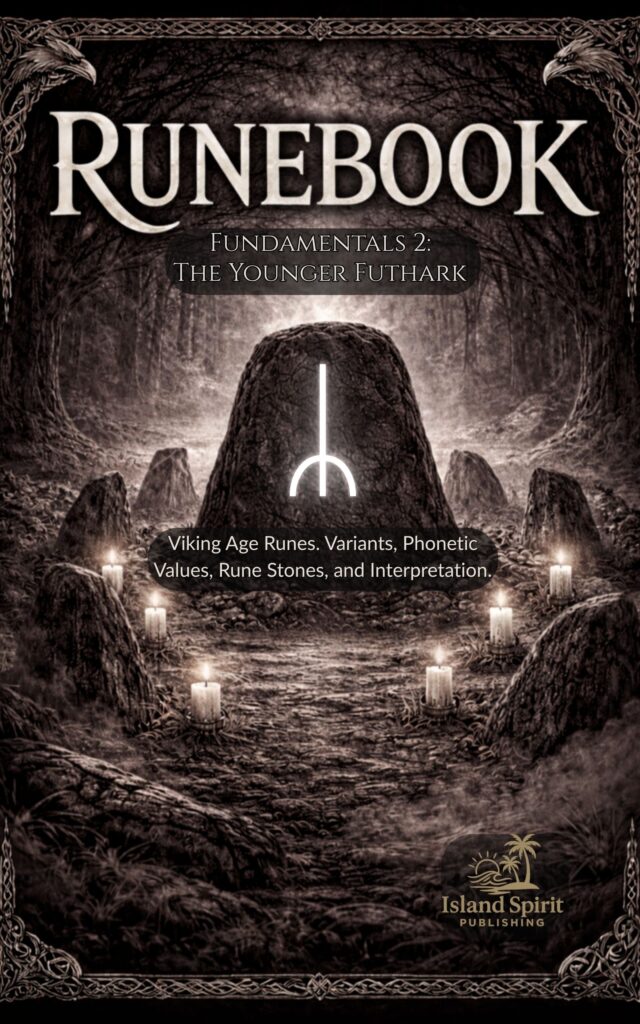
Runebook Fundamentals 2: The Younger Futhark
Viking Age Runes. Variants, Phonetic Values, Rune Stones, and Interpretation.
Guide & Non-Fiction
Language: English
This book helps you approach the Younger Futhark in a clear, grounded, and practical way. The focus is on the runes of the Viking Age, their variants, phonetic values, rune stones, and interpretation, as well as the question of how to understand this later rune system in a more structured and historically informed way.
What is this book about?
Many people first come across the Elder Futhark and only later realize that the Viking Age developed its own more compact rune system. That is exactly where this book begins. It helps you see the Younger Futhark not just as a shortened continuation of earlier runes, but as a distinct system with its own historical context, variants, phonetic values, and interpretive challenges.
The main focus is the question of how to truly understand the runes of the Viking Age. The book helps connect rune stones, historical background, modern interpretation, and practical understanding in a way that gives you a more solid foundation for further learning.
Who is this book for?
This book is especially suited for you if you want to explore the runes of the Viking Age seriously and are looking for a clear, grounded, and practical introduction.
It is a good fit for beginners, spiritually interested readers, historically curious learners, and anyone who wants to understand the Younger Futhark in more than a surface-level way. If you have already encountered runes before, but still feel unsure about how variants, phonetic values, rune stones, and interpretation actually connect, this book gives you a more reliable starting point.
It is less suited for readers who only want very fast rune meanings without background, context, and a structured learning approach.
What you will find inside the book
Inside the book, you get a clear and well-structured overview of what the Younger Futhark is and what really matters when learning and interpreting this rune system.
You learn the Viking Age runes with their variants and phonetic values and understand why historical foundations and rune stones matter so much for a sound interpretation.
You get orientation on how historical background, modern interpretation, and practical applications can be connected in a meaningful way.
You understand why working with the Younger Futhark is not only about symbolism or intuition, but also about structure, context, and careful interpretation.
You do not get a superficial overview, but a rune guide that combines knowledge, practical usefulness, and reference value.
Overall, the book helps you move beyond simply finding the Younger Futhark interesting and begin to understand and use it in a more informed and thoughtful way.
Understanding Viking Age runes takes more than just an interest in Norse symbols
The Younger Futhark can be fascinating, historically rich, and spiritually meaningful. What matters, though, is not only whether Viking Age runes appeal to you, but whether you are willing to engage with variants, phonetic values, rune stones, and careful interpretation as well. That is exactly what this book helps you do in a clearer and more grounded way.
Other language versions
This book is also available in German.
More related books
If you are interested in runes, Norse topics, interpretation systems, and more structured introductions to connected subject areas, these books may also be relevant to you:
Runebook Fundamentals 1: The Elder Futhark
Helpful if you want to understand the earlier rune system with its 24 runes, phonetic values, historical foundations, and modern interpretation in more depth.
Runebook Fundamentals 3: Casting and Interpreting Runes
A strong next step if you want to move from foundations into practical rune work, spreads, interpretation logic, meditation, and rituals.
Feedback on this book
Do you have questions, suggestions, or feedback about this book? Feel free to send your message through the contact page. That way, your feedback can be assigned clearly and used for future improvements.